

Chronic Tendonitis : Persistent, nagging tendon pain that flares up every time you climb stairs, lift your arm overhead, or run for the bus can quickly dominate your daily routine. Many people spend months cycling through ice, anti-inflammatory medications, complete rest, and cortisone injections, only to find that their pain returns the moment they resume normal activities.
Tendon recovery requires a fundamentally different biological approach. Long-term tendon pain is rarely an ongoing active inflammation; instead, it represents tendinopathy (tendinosis), a chronic state of structural collagen disorganisation and impaired tissue healing. Because tendons require targeted mechanical stimulus to remodel and heal, passive rest alone does not resolve chronic tendon dysfunction.
For residents across Western Sydney and the Hills District, including Parramatta, Merrylands, Granville, Greystanes, Northmead, Baulkham Hills, and Castle Hill, modern physiotherapy bridges the gap with progressive load-management protocols and advanced interventions like shockwave therapy, helping you rebuild tendon capacity and live pain-free.
Understanding Tendonitis vs. Tendinopathy: Why Rest Fails
Traditionally, recurring tendon aches were labelled “tendonitis,” implying ongoing acute inflammation. Contemporary orthopaedic and sports medicine research has shifted toward the Tendon Continuum Model developed by Australian researchers Prof. Jill Cook and Dr. Craig Purdam:
- Reactive Tendinopathy: A short-term, acute response to an abrupt overload or compression, causing temporary cellular swelling without extensive collagen breakdown.
- Tendon Dysrepair & Degenerative Tendinopathy: When overloaded chronically without sufficient biological capacity, the tightly packed parallel Type I collagen fibres separate, disorganise, and develop ingrowth of small sensory nerve fibres and blood vessels (neovascularisation).
At this chronic stage, taking anti-inflammatory pills or staying immobilised on the couch causes the surrounding musculotendinous unit to lose load capacity. Once normal activity resumes, the deconditioned tendon is subjected to the same tensile load, triggering persistent pain cycles. True rehabilitation lies not in avoiding load, but in applying the right type, magnitude, and progression of mechanical loading.
Common Chronic Tendon Conditions Treated
Specialised tendon rehabilitation successfully targets several high-frequency clinical presentations:
- Achilles Tendinopathy (Mid-portion & Insertional): Common among runners, walkers, and active individuals in Western Sydney, presenting as morning stiffness, localized thickening, and heel pain.
- Rotator Cuff Tendinopathy & Supraspinatus Tendinitis: Pain reaching overhead, putting on a jacket, or sleeping on the affected shoulder, frequently coupled with subacromial bursitis.
- Patellar Tendinopathy (Jumper’s Knee): Localized ache at the inferior pole of the kneecap aggravated by squatting, jumping, driving, or navigating downhill stairs.
- Lateral Epicondylalgia (Tennis Elbow): Chronic outer elbow pain and diminished grip strength triggered by computer typing, manual trades, or racquet sports.
- Gluteal Tendinopathy (Greater Trochanteric Pain Syndrome – GTPS): Lateral hip pain exacerbated by lying on the affected side at night, crossing legs, or prolonged walking.
- Plantar Fasciopathy: Although aponeurotic rather than a pure tendon, it follows similar degenerative pathways, producing sharp, stabbing morning heel pain upon taking the first steps out of bed.
Key Pillars of Evidence-Based Tendon Physiotherapy
Rebuilding a tendon’s load-carrying capacity demands a structured, multi-phase clinical progression:
1. Isometric Loading for Rapid Analgesia
Heavy, sustained isometric muscle contractions (holding tension without changing muscle length) induce cortical inhibition and stimulate local pain-relieving mechanisms. This allows patients to reduce localized pain within sessions without placing compressive or high-velocity strain on the tendon.
2. Heavy Slow Resistance (HSR) and Eccentric Training
Progressing from isometrics to slow, controlled isotonic loading stimulates cellular mechanotransduction. This process signals tenocytes (tendon cells) to synthesize new, robust collagen bundles and align them parallel to lines of pull. High-load, low-velocity exercises strengthen the whole kinetic chain, including adjacent stabilizers.
3. Energy Storage and Plyometric Retraining
For runners, court athletes, and active individuals, a tendon must behave like a functional spring, storing and releasing elastic strain energy. Advanced phases of rehabilitation gradually reintroduce stretch-shortening cycle (SSC) exercises, hopping drills, and change-of-direction mechanics to safeguard against future flare-ups.
4. Radial Extracorporeal Shockwave Therapy (ESWT)
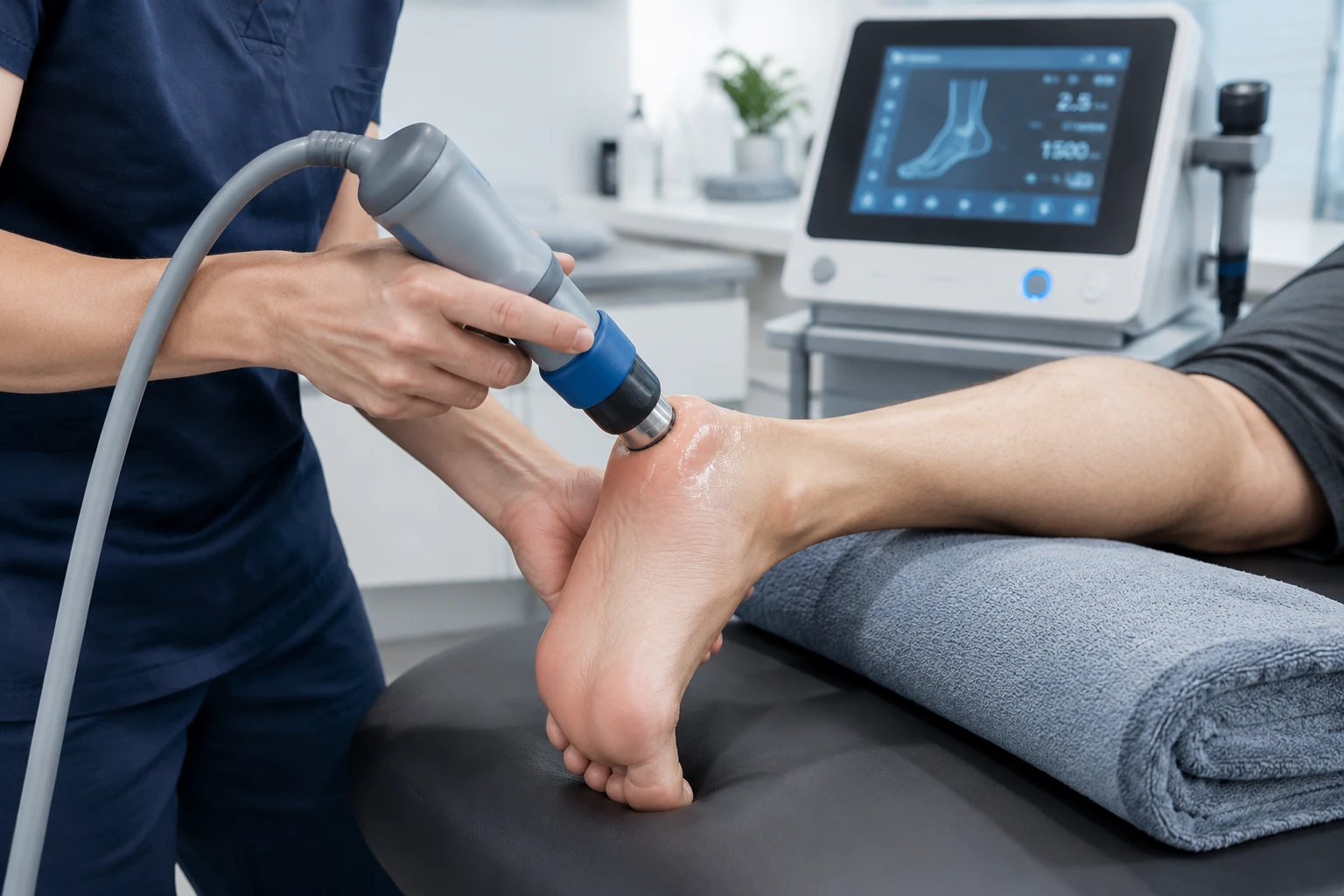
For chronic, recalcitrant tendon conditions that have resisted conservative care for over 3 to 6 months, Radial Shockwave Therapy delivers acoustic sound waves directly to the injured site. This triggers microtrauma that prompts tissue revascularisation, breaks down fibrotic adhesions, and down-regulates Substance P (a key pain mediator) to jump-start cellular repair.
5. Biomechanical Assessment and Kinetic Chain Correction
Tendons rarely break down in isolation; they are often the victims of biomechanical deficits elsewhere in the movement chain. Physiotherapists evaluate ankle dorsiflexion, pelvic stability, core activation, foot posture, running gait kinematics, and workplace ergonomics to eliminate unnecessary compressive and tensile overload.
Funding Pathways for Tendon Care in New South Wales
Accessing structured, private musculoskeletal physiotherapy in Sydney is straightforward across multiple health schemes:
- Private Health Insurance: Instant electronic claiming via HICAPS for private health funds including Bupa, Medibank Private, HCF, NIB, Australian Unity, Teachers Health, and CBHS.
- Medicare Chronic Disease Management (EPC / CDM): For individuals managing long-standing, multi-factorial musculoskeletal pain, a GP-issued referral provides Medicare rebates for up to 5 allied health consultations per year.
- WorkCover NSW (SIRA) & CTP Claims: Direct, fully covered rehabilitation for workers and injured motorists recovering from occupational repetitive strain or motor vehicle trauma.
- DVA (Department of Veterans’ Affairs): Fully funded clinical treatment for eligible White and Gold Card veterans presenting with a medical referral (D904).
Comprehensive Tendon Rehabilitation Across Western Sydney & The Hills
Overcoming chronic tendon pain requires clear diagnostic clarity and progressive, structured exercise progression close to home.
Whether you reside in central commercial hubs like Parramatta and Granville, family-oriented suburbs like Merrylands and Greystanes, or the Hills District communities of Baulkham Hills, Castle Hill, and Northmead, specialised musculoskeletal physiotherapy delivers evidence-based, results-driven treatment to restore your functional capabilities.
Every patient begins with an extensive initial consultation: establishing precise symptom irritability, assessing tendon load tolerance, reviewing imaging where relevant (such as diagnostic ultrasounds or MRIs), and formulating a realistic, periodised recovery roadmap that fits your lifestyle.
Frequently Asked Questions
Why shouldn’t I get a cortisone injection for chronic tendonitis?
While a corticosteroid injection can provide rapid, short-term pain relief by suppressing inflammation, multiple high-quality randomized controlled trials show it can weaken the tendon’s structural integrity over time. Cortisone increases the risk of cellular necrosis and partial or complete tendon rupture, with recurrence rates often higher at 6 and 12 months compared to active exercise therapy.
How long does it take for a chronic tendon to heal?
Because tendons have a low metabolic rate and limited intrinsic blood supply compared to muscles, biological collagen remodeling is a gradual process. Most patients experience notable symptom reduction within 4 to 6 weeks of structured loading, while full structural remodeling and return to high-impact activities generally requires 3 to 6 months of disciplined progressive loading.
Should I completely stop running or playing sports while rehabilitating my tendon?
Complete rest is typically counterproductive because it leads to further deconditioning of the tendon and surrounding muscles. Physiotherapists utilize a “traffic light” symptom monitoring model: mild discomfort (0–3 out of 10) during or after activity is acceptable, provided it settles back to baseline within 24 hours without progressive morning stiffness. Your therapist will help modify activity levels rather than stopping completely.
When is Shockwave Therapy recommended?
Shockwave therapy is strongly recommended when tendon pain has persisted for longer than 6 to 12 weeks and has plateaued with basic exercise. It is particularly effective for calcific shoulder tendinitis, insertional and mid-portion Achilles tendinopathy, proximal hamstring tendinopathy, and recalcitrant plantar fasciitis.
Take Control of Your Tendon Health Today
You don’t have to accept recurring tendon pain as an inevitable part of aging or activity. With the right clinical assessment, load management strategy, and advanced physical therapies, tendons can rebuild their strength and capacity.
Whether you live or work in Parramatta, Merrylands, Castle Hill, Baulkham Hills, or surrounding Western Sydney suburbs, our dedicated musculoskeletal physiotherapy team is here to guide your recovery.
Contact our clinic today to book an initial tendon assessment and start rebuilding your active lifestyle.