Shockwave Therapy vs. Manual Therapy: Which Is Right for Your Injury?
When dealing with stubborn, persistent pain ، whether it is an agonizing morning heel pain, a stiff shoulder, or chronic tennis elbow، finding the right clinical treatment can feel overwhelming. Patients often ask their clinicians a critical question: “Should I get Shockwave Therapy, or is hands-on Manual Therapy better for my recovery?”
Both Extracorporeal Shockwave Therapy (ESWT) and Manual Therapy are evidence-based, highly regarded modalities in modern musculoskeletal physiotherapy. However, they operate on completely different biological mechanisms and serve unique therapeutic purposes.
If you are navigating injury rehabilitation across Western Sydney and the Hills District—from Parramatta and Merrylands to Baulkham Hills, Castle Hill, Granville, Greystanes, and Northmead—this comprehensive guide breaks down how both treatments work, their scientific distinctions, and how to determine which option is best suited for your condition.
What is Extracorporeal Shockwave Therapy (ESWT)?
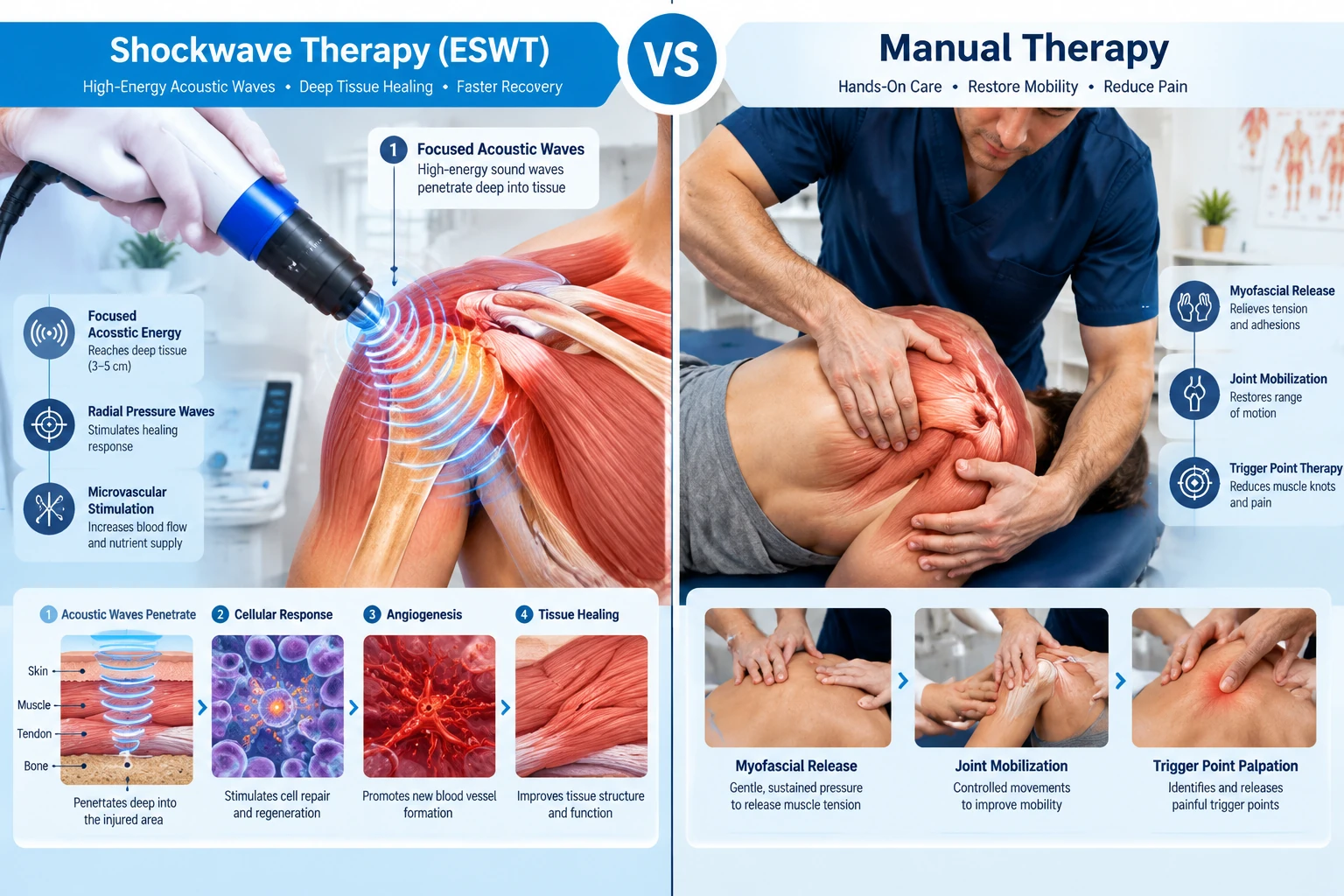
Shockwave Therapy is a non-invasive, high-energy acoustic treatment that accelerates tissue healing. Developed originally from medical lithotripsy, radial and focused shockwaves deliver mechanical sound waves directly through the skin into damaged, poorly vascularised musculoskeletal tissue.
Key biological mechanisms include:
Neovascularisation: Stimulates the growth of microscopic new blood vessels, bringing nutrient-rich blood to stubborn, ischemic areas.
Substance P Depletion: Temporarily down-regulates Substance P (a primary neurotransmitter responsible for transmitting pain signals), delivering rapid pain relief.
Collagen Synthesis: Converts chronic degenerated tissue into active repairing collagen structures.
Breakdown of Calcification: Effectively decalcifies chronic calcific tendonitis in the rotator cuff and heel.
What is Manual Therapy?
Manual Therapy represents the art and science of skilled, hands-on clinical techniques administered by qualified physiotherapists and musculoskeletal practitioners. Rather than relying on acoustic devices, manual therapy utilizes targeted mechanical pressure and passive joint movement to modulate neural pain pathways and restore functional biomechanics.
Key manual therapy modalities include:
Joint Mobilisations and Manipulations: Rhythmic, passive oscillatory movements to restore synovial lubrication, increase range of motion, and release capsular restrictions.
Myofascial Release and Deep Tissue Trigger Point Therapy: Relieves deep muscle guarding, breaks down scar adhesions, and improves localized tissue elasticity.
Passive Muscle Energy Techniques (MET): Activates reciprocal inhibition pathways to reset hypertonic muscles.
Shockwave Therapy vs. Manual Therapy : Key Difference
Understanding how these two modalities differ helps clarify why clinicians choose one over the other:
Primary Mechanism: Shockwave uses acoustic sound waves to stimulate cellular and micro-vascular healing, whereas manual therapy relies on hands-on mechanical force to modulate neurological tone and joint biomechanics.
Target Tissue: Shockwave directly targets chronic, poorly vascularized tendons, ligaments, and calcified deposits. Manual therapy targets stiff articular joints, hypertonic muscle bands, and neural or fascial restrictions.
Stage of Injury: Shockwave is ideal for chronic, degenerative conditions persisting longer than 6 to 12 weeks. Manual therapy is effective across acute, sub-acute, and chronic mechanical dysfunctions.
Treatment Frequency: Shockwave typically requires 3 to 6 sessions spaced one week apart. Manual therapy is usually performed 1 to 2 times weekly alongside an active exercise program.
Treatment Sensation: Shockwave delivers a rhythmic pulsation or localized ache during application. Manual therapy involves deep pressure, stretching sensations, or joint cavitation.
Post-Treatment Care: Shockwave requires avoiding heavy tendon loading for 24 to 48 hours post-session. Manual therapy requires minimal downtime, with only mild transient muscle soreness in some cases.
Which Treatment Suits Your Specific Injury?
When Shockwave Therapy is the Superior Choice
Shockwave is clinically proven to be highly effective when conservative hands-on treatments fail to resolve chronic tendinopathies and fibrous degeneration:
- Plantar Fasciitis: Severe, stabbing heel pain with morning weight-bearing.
- Achilles Tendinopathy: Mid-portion or insertional heel cord pain.
- Lateral and Medial Epicondylalgia: Chronic Tennis Elbow or Golfer’s Elbow resistant to stretching.
- Calcific Tendonitis of the Shoulder: Supraspinatus tendon calcification causing impingement.
- Greater Trochanteric Pain Syndrome (Gluteal Tendinopathy): Persistent lateral hip pain aggravated by side-lying or stairs.
- Patellar Tendinopathy (Jumper’s Knee): Anterior knee pain directly below the kneecap.
When Manual Therapy is the Superior Choice
Manual therapy shines when the root cause involves articular stiffness, joint misalignment, neural entrapment, or acute muscle guarding:
Acute Low Back Pain and Sciatica: Lumbar facet joint locks, discogenic muscle spasms, and sacroiliac joint dysfunction.
Cervical Spine Pain and Tension Headaches: Postural neck stiffness, whiplash recovery, and cervicogenic headaches.
Frozen Shoulder (Adhesive Capsulitis): Capsule tightness requiring gentle, progressive joint mobilisations.
Post-Surgical or Post-Cast Stiffness: Restoring functional joint movement following immobilization.
The Synergistic Approach: Combining Both Therapies
Modern musculoskeletal medicine has moved beyond “either/or” thinking. In a best-practice clinical setting, Shockwave Therapy and Manual Therapy complement each other seamlessly:
Step 1 (Shockwave): Breaks down the chronic degenerative cycle within an inflamed tendon and dampens local pain signals.
Step 2 (Manual Therapy): Restores mobility to adjacent stiff joints and loosens surrounding tight myofascial chains that were overloading that tendon in the first place.
Step 3 (Active Rehabilitation): Progressive eccentric and isometric loading to build long-term load tolerance and prevent recurrence.
Dedicated Musculoskeletal Care in Western Sydney and The Hills District
If chronic joint or tendon pain is keeping you from staying active, working comfortably, or enjoying your daily routine, expert assessment is readily available.
Whether you reside in Parramatta, Granville, Merrylands, Greystanes, or across the northern corridor of Northmead, Baulkham Hills, and Castle Hill, comprehensive multidisciplinary physiotherapy care is within easy reach.
A comprehensive biomechanical evaluation ensures an accurate diagnosis—identifying whether your recovery requires radial shockwave, precise manual therapy, or an integrated rehabilitation plan tailored to your specific goals.
Frequently Asked Questions about Shockwave Therapy vs. Manual Therapy
Is Shockwave Therapy painful?
Shockwave therapy can cause a mild-to-moderate tapping sensation or a dull ache over the treatment site. Modern devices allow your physiotherapist to fine-tune the energy frequency and intensity to stay well within your comfort threshold. A typical shockwave application lasts only 4 to 8 minutes per area.
Can I claim Shockwave and Manual Therapy on private health insurance in Australia?
Yes. When delivered by an AHPRA-registered Physiotherapist, both Shockwave Therapy and Manual Therapy are claimable on the spot via HICAPS under standard Physiotherapy Extras cover with funds such as Bupa, Medibank, HCF, NIB, and Teachers Health.
How soon will I see results from Shockwave Therapy?
Many patients experience immediate pain modulation following their first session due to the temporary deactivation of pain neurotransmitters. However, structural collagen remodeling and true tissue repair typically occur over a 6-to-12 week period following the full treatment course.
Do I need a doctor’s referral to book a consultation?
No. In Australia, physiotherapists are primary contact practitioners. You do not need a GP referral to access Manual Therapy or Shockwave Therapy, unless you are claiming under WorkCover NSW, CTP insurance, DVA (Department of Veterans’ Affairs), or an EPC/CDM Medicare Care Plan.
Take the Next Step Toward Pain-Free Movement
Do not let chronic injury dictate your lifestyle. Whether you are dealing with persistent plantar fasciitis in Merrylands, rotator cuff stiffness in Parramatta, or Achilles pain in Baulkham Hills, professional evidence-based care will help you regain your mobility.
Book your comprehensive musculoskeletal evaluation today and discover the right treatment pathway for your recovery.